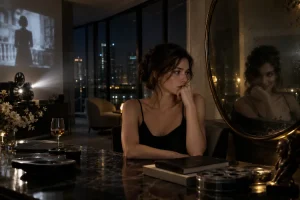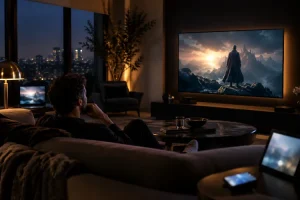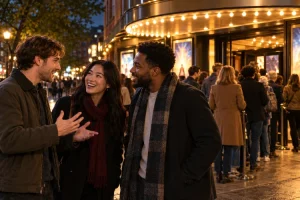
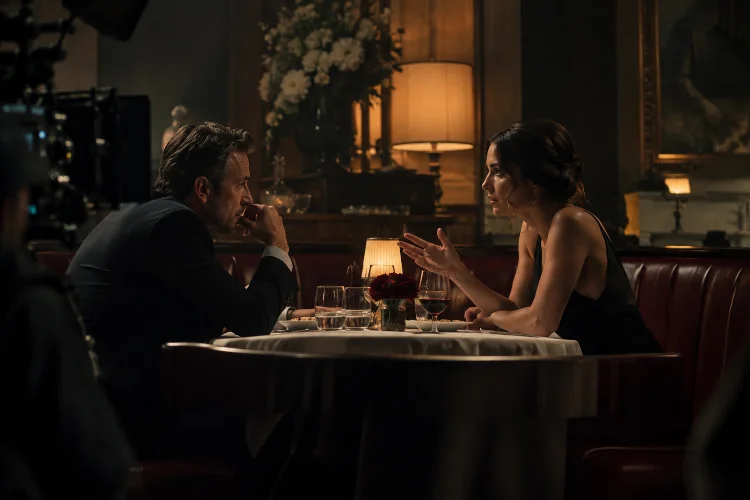
Some of the most gripping movie scenes involve almost no physical action. Two people sit across a table, talk for several minutes, and somehow the tension feels stronger than a car chase.
The secret is often rhythm.
In dialogue-heavy sequences, directors cannot rely constantly on explosions, location changes, or large movements to keep an audience engaged.
Also Read
Instead, they control when characters speak, how long silence lasts, when the camera cuts, whose reaction we see, and whether the actors remain still or begin moving.
Analysing directorial rhythm across dialogue-heavy film sequences therefore means looking beyond the words themselves. A screenplay provides the lines, but directing determines how those lines breathe.
A conversation can feel rapid and aggressive, painfully awkward, quietly intimate, or increasingly dangerous depending on its visual and performative tempo.
Great directors understand that dialogue scenes are not static. Even when characters barely move, timing creates motion. The scene develops through changes in speed, silence, attention, and emotional pressure.
Rhythm Starts With Performance, Not Editing
Before an editor makes a single cut, rhythm already exists in the actors’ performances.
Consider how differently one sentence can sound depending on delivery.
“I knew you would come back” might be spoken immediately, with excitement. The same sentence delivered after a five-second silence can feel suspicious, sad, threatening, or deeply relieved.
Directors therefore shape rhythm through pauses, interruptions, hesitation, overlap, repetition, and changes in speaking speed.
This is especially important when a scene contains several pages of conversation. If every character delivers lines at the same pace, the dialogue starts feeling mechanically rehearsed.
Natural conversations are rarely that clean.
People interrupt. They hesitate. Someone starts speaking and changes direction halfway through. Another person waits longer than expected before answering.
That irregularity creates rythym.
The director’s job is not necessarily to make dialogue perfectly realistic, but to design a pattern that supports the emotional purpose of the scene.
Pauses Can Become More Powerful Than Dialogue
Silence is one of the strongest tools available in a dialogue-heavy sequence.
Suppose Character A asks, “Did you tell her?”
Character B answers immediately: “No.”
Now imagine Character B waits eight seconds before saying exactly the same word.
Nothing in the screenplay has changed, yet the second version contains much more information.
The pause creates suspicion.
Directors can use silence to force audiences to examine an actor’s face, reconsider the previous line, or anticipate what might come next. The absence of dialogue temporarily becomes the most important part of the dialogue scene.
This also explains why cuts need to happen at psychologically meaningful moments.
A discussion of Laurence Olivier’s Hamlet from the BFI notes that its relatively limited cutting made the timing of individual edits particularly important; cuts could follow physical movement or the rhythm of Shakespeare’s speech.
When a sequence depends heavily on words, cutting half a second too early can remove the emotional aftershock of a line.
Reaction Shots Control How Dialogue Feels
A common mistake when analysing dialogue scenes is watching only the person speaking.
Directors often care just as much about the listener.
A reaction shot can reveal whether a joke worked, whether a threat landed, whether someone believes a lie, or whether information has quietly changed a relationship.
StudioBinder describes reaction shots as useful for conveying emotion, controlling pacing, and giving editors flexibility within dialogue sequences.
Imagine a father announcing during dinner that the family is moving abroad.
The director could remain on him throughout the speech.
But what if the camera cuts to his teenage daughter halfway through?
Her expression might completely redefine the scene.
The dialogue belongs to the father, but emotionally the moment may belong to the person listening.
This is why sophisticated shot/reverse-shot editing does not simply alternate every time the speaker changes.
Sometimes staying on the listener creates far more tension.
Shot Length Creates an Invisible Tempo
Every shot has duration.
Put several short shots together and the sequence generally begins feeling faster. Allow shots to continue longer and the audience becomes more aware of pauses, body language, and uncomfortable space.
Neither approach is automatically better.
The appropriate pace depends on what the conversation is doing.
A heated negotiation might accelerate through shorter exchanges. A confession may need long uninterrupted takes that prevent both the character and audience from escaping the moment.
StudioBinder’s discussion of dialogue editing emphasizes that editors create pace partly through decisions about how long shots remain on screen and whether pauses between lines are preserved or removed.
This creates an important relationship between directing and editing.
The director provides the performances, camera coverage, and visual strategy. The editor later determines exactly how long each emotional beat survives.
A good dialogue scene often has something resembling musical phrasing: acceleration, pause, repetition, release.
Blocking Keeps Long Conversations Visually Alive
Characters do not need to remain seated simply because a scene contains a lot of dialogue.
Blocking can create internal chapters within a conversation.
Two characters might begin far apart. One gets up halfway through the exchange, walks toward a window, and eventually moves behind the other person.
Their changing positions visually track the emotional development of the conversation.
MasterClass describes blocking as involving actor position, movement, body language, camera placement, and the way those choices guide audience attention and emotional engagement.
The important point is that movement should usually have motivation.
A character should not randomly cross the room becuase the director is worried viewers are bored.
Perhaps they move because they want to avoid eye contact. Perhaps they pour a drink to delay answering a difficult question.
When physical behaviour grows from psychology, blocking becomes part of the dialogue even though nobody is speaking.
Camera Movement Can Signal Changes in Emotional Pressure
A mostly static conversation can suddenly feel different when the camera begins moving.
Imagine two politicians negotiating across a desk.
For several minutes, the camera remains locked.
Then one reveals information capable of destroying the other’s career. The camera begins an almost invisible push toward the listener.
That movement creates emphasis without announcing itself loudly.
Paul Thomas Anderson provides an interesting example of varying visual rhythm across his films.
A BFI analysis of The Master observes that although the film contains some notable tracking shots, it frequently settles into shot/reverse-shot conversations and close views of faces, using restrained camera strategy for psychological intimacy.
Camera movement therefore does not need to remain constant.
Its absence establishes a baseline.
Once that baseline exists, even a small push-in can feel enormous.
Overlapping Dialogue Makes Conversations Feel Faster
Directors can alter rhythm without changing the actual amount of dialogue.
One method is overlap.
If Character B starts responding before Character A finishes speaking, the scene immediately feels more energetic. Multiple interruptions can suggest familiarity, excitement, hostility, impatience, or chaos.
Clean seperation between every line produces a completely different effect.
Editing techniques such as J-cuts and L-cuts can extend this principle visually. Instead of cutting automatically to whoever begins speaking, editors can let one character’s voice continue while the image remains on another person’s reaction.
StudioBinder notes that these techniques can create more natural dialogue flow and allow the listener’s emotional response to remain visible while another character speaks.
This prevents the sequence from becoming a mechanical pattern of “person talks, cut; other person talks, cut.”
Image and dialogue develop separate rhythms.
That separation gives directors and editors much more control.
Ensemble Dialogue Requires Controlling Audience Attention
A conversation between two people is already complicated.
Put eight people in the same room and rhythm becomes an even bigger directing challenge.
Who speaks first? Who interrupts? Which characters remain silent? Where should the audience look when several conversations happen simultaneously?
Robert Altman’s Nashville demonstrates a radically different approach from traditional dialogue construction.
BFI’s Sight and Sound notes that Altman used multi-track recording, improvisational dialogue, multiple cameras, and wide compositions containing numerous characters.
Rather than relying entirely on conventional shot/reverse-shot grammar, he pursued something closer to the overlapping complexity of real social environments.
This creates a different kind of cinematic rhythm.
Instead of directing attention toward one perfectly isolated line at a time, the filmmaker allows conversations to compete.
The audience may feel as though life is continuing beyond whichever character currently occupies the narrative foreground.
Breaking Traditional Continuity Can Create Psychological Rhythm
Smooth dialogue coverage helps audiences understand who is talking to whom.
But clarity is not always the goal.
Carl Theodor Dreyer’s The Passion of Joan of Arc famously uses close-ups and unconventional spatial relationships. BFI notes that inconsistent eyelines sometimes obscure clear spatial geography even though viewers can still understand who is interacting.
That disruption changes the emotional experience.
Instead of comfortably observing a conventional conversation, viewers encounter faces in an intense and sometimes destabilizing visual pattern.
This illustrates an important principle: directorial rhythm is psychological as well as temporal.
A dialogue sequence can become unsettling because cuts arrive where viewers do not expect them, because spatial relationships feel unstable, or because familiar conversational grammar disappears.
Breaking the pattern works best after the audience understands the pattern that is being broken.
Rhythm Should Change as the Scene Changes
The strongest dialogue scenes rarely maintain exactly the same tempo from beginning to end.
Imagine a ten-minute interrogation.
It might begin slowly, with long takes and polite questions.
The suspect becomes uncomfortable. Answers get shorter. Cuts become more frequent. Questions begin overlapping. The interrogator moves closer.
Then comes the crucial confession.
Suddenly everything stops.
One long shot holds on the suspect.
That final stillness feels powerful precisely because the sequence accelerated before it.
This is how directors can think about dialogue rhythm structurally.
Do not ask only whether a scene is “fast” or “slow.” Ask where it accelerates, where it pauses, when the camera changes behaviour, and which character begins controlling the tempo.
A dialogue scene becomes engaging when its rhythm evolves alongside its emotional stakes.
Directorial rhythm is what turns pages of conversation into cinema.
Actors create tempo through speech, pauses, interruptions, and silence. Blocking introduces physical variation, while camera movement can increase intimacy or pressure.
Reaction shots determine whose emotions matter, and editing controls exactly how long each moment lasts.
The strongest dialogue-heavy sequences also understand contrast. Fast exchanges become more intense when followed by silence. Static compositions make a sudden push-in meaningful.
A long-held reaction can sometimes communicate more than another paragraph of dialogue. Next time you watch a conversation-heavy film scene, stop listening only to the words.
Notice when people pause, when the camera cuts, whose face remains on screen, and when the visual pattern changes. That hidden rythym is often where the director is doing the most interesting work.