
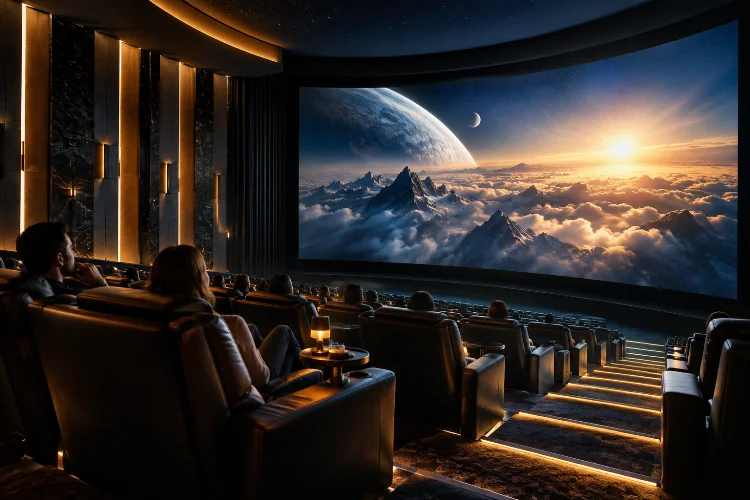
Going to the movies is no longer just about choosing which film to watch. Audiences increasingly choose how they want to watch it.
A standard screen might be perfectly fine for a comedy or drama. But when a huge science-fiction adventure, racing movie, or Christopher Nolan epic arrives, some viewers actively search for IMAX, Dolby Cinema, 4DX, ScreenX, 3D, or another premium experience.
That shift has important consequences for the theatrical business.
Also Read
Premium formats influence modern box office performance because they can increase average ticket prices, create scarcity around desirable showtimes, encourage advance booking, and turn certain films into events that feel difficult to reproduce at home.
Their importance is becoming increasingly visible. IMAX reported a record $1.28 billion in worldwide box office during 2025, while Dolby said 2024 was Dolby Cinema’s strongest box office year at the time.
Premium screens may represent only part of the cinema market, but their economic impact can be much larger than their physical footprint suggests.
Premium Formats Turn a Movie Into an Experience
The basic purpose of premium cinema is straightforward: make the theatrical experience feel noticeably different from watching the same movie elsewhere.
IMAX emphasizes screen scale, projection technology, sound, and specialized presentation. Dolby Cinema combines Dolby Vision imaging with Dolby Atmos audio.
Meanwhile, formats such as 4DX introduce motion seats and environmental effects, while ScreenX extends images across additional walls.
These differences can change audience behaviour.
When the theatrical experiance feels unique, moviegoers have a stronger reason to leave home rather than wait for streaming. This is particularly important in an era when many viewers already own large televisions, sound systems, and multiple streaming subscriptions.
Premium presentation therefore adds another selling point beyond the movie itself.
The question becomes not simply, “Do I want to see this movie?” but, “Do I want to experience this movie on the biggest and best screen available?”
Higher Ticket Prices Can Lift Box Office Revenue
One obvious advantage of premium formats is higher average ticket pricing.
A premium-format ticket commonly costs more than a conventional screening. That means a movie does not necessarily need more viewers to generate additional gross revenue.
Imagine a standard auditorium selling 200 tickets at $12 each. That screening produces $2,400.
Now imagine a premium auditorium selling the same number of seats at $20. Revenue rises to $4,000 even though admissions have not changed.
Real pricing varies considerably by country, theatre chain, time, and format, but the underlying economics remain the same.
This helps explain why premium-format market share can be disproportionately large compared with its number of screens.
In 2025, IMAX generated approximately 3.8% of worldwide box office while operating from just over 1,800 locations globally. The company recorded $1.28 billion in global box office for the year, a 40% increase from 2024.
That kind of performance shows why studios and exhibitors pay close attention to premium capacity.
Some Movies Generate Extraordinary Premium Demand
Not every movie benefits equally from premium presentation.
Large-scale visual spectacles tend to have an obvious advantage.
Avatar: The Way of Water is a strong example. During its 2022 opening weekend, around 62% of ticket revenue came from premium formats such as IMAX and 3D. IMAX alone generated approximately $48.8 million globally during the opening.
The pattern continued with Avatar: Fire and Ash. Premium formats, including IMAX and 3D, represented about 66% of its opening grosses in 2025.
IMAX generated $43.6 million globally during the launch, amounting to nearly 14% of worldwide opening revenue despite representing less than 1% of screens.
That is an enormous difference.
It demonstrates why simply counting screens can be misleading. A relatively small collection of highly valuable premium auditoriums can generate a much larger percentage of revenue than standard screen counts would suggest.
IMAX Has Become Part of the Marketing Strategy
Premium formats are no longer only exhibition technologies. In some cases, they are built directly into how films are produced and marketed.
Christopher Nolan’s movies provide the clearest example.
Oppenheimer became closely associated with IMAX 70mm before its 2023 realease. The scarcity of those screenings turned the format itself into part of the movie’s cultural conversation.
The results were substantial.
By August 2023, Oppenheimer had generated approximately $146.4 million from IMAX screens worldwide. At that point, it had become one of the five highest-grossing IMAX releases ever.
That strategy evolved further with Nolan’s The Odyssey. IMAX reported that its July 2026 opening generated $52 million globally from the format, representing 20% of the film’s worldwide debut in the markets included in the company’s comparison.
When audiences specifically search for “IMAX 70mm” rather than simply the movie title, the exhibition technology has effectively become part of the product.
Premium Screens Can Create Scarcity and Urgency
There are thousands of conventional cinema screens, but significantly fewer premium auditoriums.
That creates scarcity.
If a blockbuster receives only one IMAX auditorium in a city, popular evening performances can sell out quickly. Audiences who want that specific format may buy earlier than they normally would.
Scarcity can therefore strengthen presales and opening-weekend demand.
It can also influence competition between movies.
Two major releases cannot occupy the same premium auditorium at the same time. Studios consequently have strong incentives to secure desirable IMAX, Dolby Cinema, and other PLF screens during important opening periods.
A film that loses those auditoriums to a competing realease may still play widely across standard screens, but it can lose some of its highest-value capacity.
Premium screen allocation is therefore both a technical decision and a strategic box office issue.
Premium Formats Can Encourage Repeat Viewing
The same person can generate box office revenue more than once.
That becomes particularly interesting when different formats provide noticeably different experiences.
A fan might watch a new blockbuster in a regular auditorium with friends, then return later for IMAX. Another viewer might choose Dolby Cinema for a second screening because of its audio presentation.
Films with dedicated fanbases are especially well positioned to benefit from this behaviour.
The effect is difficult to isolate perfectly because repeat attendance is influenced by many variables, including reviews, fandom, visual spectacle, and overall satisfaction. Still, premium options give enthusiastic viewers another reason to purchase a second ticket.
For event movies, the format itself can even become collectible in a loose sense. Fans discuss the best seats, compare IMAX 70mm with digital IMAX, or travel to another city to find a particular presentation.
That creates revenue opportunities that a conventional screening may not generate.
Premium Success Is Expanding Beyond Hollywood
Premium cinema was once strongly associated with Hollywood blockbusters, but that assumption is becoming outdated.
IMAX reported that local-language movies generated more than $405 million across its network in 2025, representing around 32% of its total global box office that year. Ne Zha 2 alone generated approximately $166.7 million for IMAX, becoming the format’s highest-grossing film of 2025.
Anime has also become increasingly important. Demon Slayer: Infinity Castle ranked among IMAX’s biggest films of 2025, generating roughly $95.9 million in the format.
This changes the business case for premium auditoriums.
A theatre operator no longer has to rely exclusively on American superhero or science-fiction franchises to fill expensive premium screens. Chinese films, Japanese anime, Indian cinema, and other regional content can also become premium-format events.
That makes the model more globally useful.
Dolby Cinema Shows Premiumisation Is Bigger Than IMAX
IMAX receives much of the attention, but the wider premiumisation trend includes several competitors and complementary technologies.
Dolby and AMC announced in 2025 that another 40 Dolby Cinema auditoriums would be added in the United States by the end of 2027. Dolby also said its cinema format achieved a record box office year in 2024, exceeding its previous record from 2023.
At that point, more than 725 theatrical features had been released or confirmed with Dolby Vision and Dolby Atmos support. Of the top 50 movie titles from the preceding five years, Dolby said 49 had played in Dolby Cinema.
Other formats such as 4DX and ScreenX target audiences in different ways.
Instead of competing only through picture size or sound quality, they can offer movement, expanded visuals, and physical immersion.
This gives cinema operators several ways to sell an experience that is difficult to duplicate in the living room.
Premium Formats Can Improve Box Office Legs
Opening weekend is not the only period where premium screens matter.
They can also support longer theatrical runs.
Strong demand for a limited number of premium screens may encourage some audiences to postpone their visit rather than choose a standard auditorium. If Saturday’s IMAX performances are sold out, a viewer might book the following weekend instead.
That behaviour can spread demand across a longer period.
Oppenheimer demonstrated how premium interest can remain meaningful far beyond opening weekend. Its IMAX success continued while the movie stayed near the top of domestic box office charts for weeks.
Of course, premium presentation cannot rescue every film.
Weak word of mouth remains weak word of mouth. Audince satisfaction, reviews, competition, scheduling, runtime, marketing, and overall demand still matter.
Premium formats amplify desirable movies more effectively than they manufacture demand from nothing.
Premium Screens Are Becoming More Important to Modern Theatres
Cinema operators face a difficult challenge: convincing people that theatrical viewing offers something worth paying for.
Premium screens are one answer.
They help theatres differentiate themselves from streaming by emphasizing scale, audio quality, visual presentation, motion technology, and exclusivity. They can also lift revenue per customer through premium ticket prices.
The growth continues.
By the end of 2025, IMAX reported 1,796 commercial locations, up from 1,735 a year earlier, with 434 systems in its backlog. The company installed 160 systems during 2025.
Its momentum remained strong in 2026. Through August 31, IMAX reported approximately $1.123 billion in global box office for the year to date.
Those numbers suggest premium cinema is not merely a novelty attached to a handful of giant blockbusters. It is becoming a larger component of theatrical economics.
Premium formats have changed the way modern box office performance should be analysed.
IMAX, Dolby Cinema, 3D, 4DX, ScreenX, and other premium experiences can raise average ticket revenue, strengthen advance sales, create scarce high-value capacity, encourage repeat viewing, and transform major releases into genuine theatrical events.
Their impact can also be remarkably disproportionate to their screen count, as movies such as Avatar, Oppenheimer, and The Odyssey have demonstrated.
But premium technology is not a magic formula. The movie still needs audience demand strong enough to justify the upgrade.
When analysing the next major box office weekend, look beyond total ticket sales and theatre count. Check how much revenue comes from premium screens. That smaller slice of the exhibition market can sometimes explain a surprisingly large part of the overall result.