A camera does not have to move just because a filmmaker owns a gimbal.
That sounds obvious, yet some of the most memorable camera movements work precisely because they have a narrative reason. A slow push toward a character can make a realization feel enormous.
A camera drifting away can create loneliness. A frantic handheld shot can put the audience inside a character’s panic without a single line of dialogue.
Also Read
That is where advanced camera movement techniques for narrative storytelling become interesting.
Movement is not simply a technical trick used to make footage look cinematic. It can control perspective, reveal information, manipulate tension, connect locations, and change how close we feel to a character.
Modern filmmakers also have more options than ever. Dollies, Steadicams, gimbals, cranes, drones, remote heads, and compact cinema cameras can create movements that once required huge crews.
But technology is only useful when the movement serves the story.
The real skill is knowing when the camera should move—and when it should stay completely still.
Push-Ins Turn Internal Emotion Into Visual Action
A push-in is one of the simplest camera movements, but it can be remarkably powerful.
The camera physically moves closer to a subject, usually with a dolly, stabilizer, or another moving platform. Unlike simply zooming the lens, a real push-in changes the spatial relationship between foreground and background.
Narratively, it often tells viewers, “Pay attention. Something has changed.”
Imagine a detective discovering that the person sitting across the table has been lying. Instead of immediately cutting to an extreme close-up, the camera can slowly move toward the detective as the information sinks in.
Nothing dramatic needs to happen physically.
The camera creates the drama.
Fast push-ins can feel aggressive or shocking, while extremely slow movements may work almost subconsciously. Sometimes viewers do not notice that the frame has gradually tightened until the character’s emotional pressure has become unavoidable.
The key is motivation. If every dialogue scene contains a push-in, the technique quickly loses its power.
Pull-Backs Can Reveal Isolation or New Information
Moving away from a character creates a very different psychological effect.
A pull-back can make someone appear smaller, more vulnerable, or increasingly disconnected from their environment. It can also reveal information that was previously outside the frame.
Imagine beginning with a close shot of a woman crying.
The camera slowly moves backward. We discover she is sitting alone in an enormous empty station. Suddenly the meaning changes. We are no longer simply observing sadness; we are seeing isolation.
A pull-back can also function as a reveal.
The audience may initially believe a character is alone, only for the camera to retreat and expose another person quietly standing in the background.
This technique is especially effective when the new information changes how viewers interpret everything they have just seen.
Good camera movment does not merely make the frame larger. It changes what the frame means.
Tracking Shots Attach the Audience to a Character
Tracking shots move through space alongside, behind, or in front of a subject.
They can make viewers feel as though they are physically travelling with a character rather than simply watching from a distance.
Adobe notes that tracking shots can establish pace, communicate emotion, introduce characters, and reveal important narrative information.
Its discussion includes Stanley Kubrick’s use of tracking in The Shining, where following Danny through the Overlook Hotel contributes to the film’s growing sense of dread.
Direction matters.
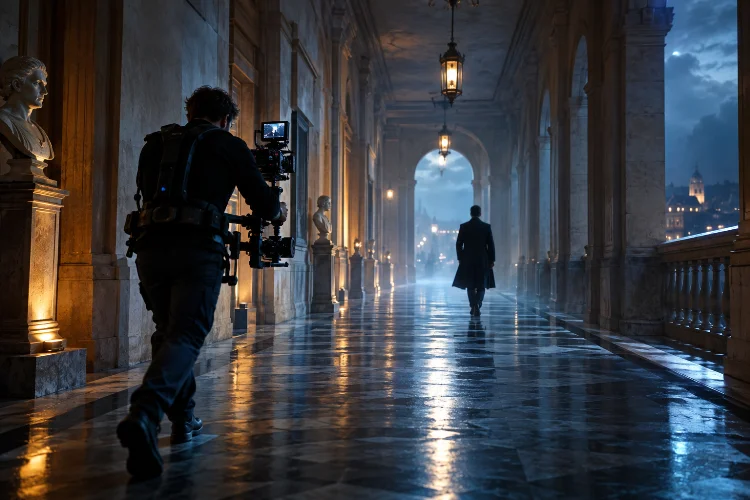
Tracking behind someone often encourages us to follow their journey. Moving backward in front of a walking character lets us study their face while the world unfolds behind them.
Lateral tracking creates a different feeling. Because the camera moves parallel to the character, viewers may feel more like observers watching events develop across a space.
The best tracking shots are rarely impressive only because they are technically smooth.
Their movement changes our relationship with the person being followed.
Orbiting the Subject Can Signal Emotional Transformation
An orbiting shot moves around a character or group rather than travelling in a straight line.
Used carefully, it can create intimacy, confusion, excitement, romance, or psychological instability.
Consider two characters having a quiet conversation.
If the camera gradually circles them, the background continuously changes while they remain the emotional center of the frame. The outside world can begin to feel less important, making the moment unusually intimate.
Circular movement can also destabilize a scene.
In Quiet Life, cinematographer Olympia Mytilinaiou described using circular shots to create a more immediate and intimate feeling, while fixed and parallel movements offered greater control in other sequences.
That contrast is important.
Advanced cinematography is often less about choosing one signature movement than creating a visual grammar. A director may establish stillness early in a film, then introduce orbiting or tracking as a character loses control.
Movement becomes meaningful because viewers have experienced its opposite.
Handheld Movement Can Put Viewers Inside Subjective Experience
Handheld cinematography is sometimes treated as shorthand for realism.
But simply shaking the camera does not automatically make a scene authentic.
Good handheld work has rhythm.
A camera might gently breathe around characters during an intimate conversation, producing a sense of human presence without becoming distracting. During panic or violence, the movement might become much more unstable.
The contrast can mirror a character’s emotional state.
Cinematographer Jih-E Peng explained that Girls Will Be Girls used camera behaviour according to the protagonist Mira’s perspective.
Rigid frames could create uncomfortable tension, while gentler handheld movement accompanied moments when Mira experienced more personal freedom.
That is a strong example of subjective camera language.
Instead of deciding that an entire film should simply “look handheld,” filmmakers can change the camera’s physical behaviour according to what a character is experiencing.
The audience may not consciously identify the technique, but they often feel the difference.
Long Takes Can Control Time and Audience Attention
A long take does more than avoid editing.
It changes the viewer’s relationship with time.
Cuts normally allow filmmakers to compress actions, jump between perspectives, and decide exactly what audiences see. A long take removes some of those escape routes.
The viewer remains trapped inside the unfolding moment.
Sam Mendes used this principle on 1917, which was designed to appear as one continuous shot.
Cinematographer Roger Deakins explained that the approach supported a real-time story about characters who were constantly moving, keeping audiences immersed in their journey rather than repeatedly releasing tension through visible cuts.
The production required multiple methods of moving the camera across trenches, fields, ruins, and other difficult environments. Handheld systems, stabilizers, cranes, vehicles, and other rigs could effectively become parts of the same continous visual journey.
But long takes should not exist only to demonstrate technical skill.
The question is always whether uninterrupted time strengthens the narrative.
Sometimes one carefully placed cut tells the story better than five minutes of choreography.
Changing Movement Styles Can Show a Story Evolving
One of the most advanced strategies is not a specific camera move at all.
It is changing the rules of movement over time.
A film might begin almost entirely with static compositions. As conflict grows, tracking movements slowly appear. Later, Steadicam or handheld shots take over as stability breaks down.
The visual language evolves with the narrative.
Cinematographer Álex de Pablo described a comparable progression while discussing The Beasts. Early portions incorporated fixed shots and pans, tracking movements were introduced as tension increased, and Steadicam became important later in the story.
This approach gives movement structural meaning.
A viewer does not need to understand cinematography terminology to sense that the world of the film has changed.
The same principle can work on a smaller scale inside one scene.
Start with a locked camera during a controlled conversation. Allow a subtle pan when someone becomes uncomfortable. Follow them when they leave the table. Switch to handheld when the argument explodes.
The camera’s behaviour becomes an emotional graph.
Camera Movement Can Manipulate What the Audience Knows
Movement is also an information-management tool.
Instead of cutting directly to an important object, the camera can gradually discover it.
This creates anticipation.
A slow pan might reveal an open window behind a character. A tracking shot may move around a wall to expose someone listening to a private conversation. A crane movement can transform a close personal moment into a huge view of the surrounding environment.
Horror filmmakers use this particularly well.
In The Invisible Man, cinematographer Stefan Duscio and director Leigh Whannell developed a visual language around a threat the audience could not actually see.
The production experimented with camera movement and motion tracking to make apparently empty areas of the frame feel meaningful.
This demonstrates a larger principle.
The camera does not have to follow visible action.
Sometimes moving toward empty space makes viewers wonder what might be there.
That question can create more tension than showing the threat directly.
Advanced Stabilizers Expand the Visual Vocabulary
Technology has dramatically expanded what filmmakers can physically achieve.
Traditional dollies remain valuable for precise linear movement, while Steadicams allow operators to travel more freely through complicated environments. Modern gimbals can move through tight locations, and cranes or remote heads can transition between very different heights.
Hybrid systems push those possibilities further.
ARRI’s TRINITY stabilization system, for example, combines mechanical and electronic stabilization. It allows operators to move smoothly between low and high positions and create angles that would be difficult with conventional setups alone.
ARRI also documented the use of a stabilized MAXIMA system on Empire of Light, including tracking movements that pushed behind actors, pulled backward in front of them, and changed height during movement.
These tools can produce extraordinary shots.
But expensive equipment cannot decide what a shot means.
A simple handheld camera moving three steps toward an actor can be more emotionally powerful than a complicated crane sequence if those three steps happen at exactly the right moment.
Motivated Movement Is More Important Than Constant Movement
One of the easiest mistakes in modern filmmaking is moving the camera simply because movement looks polished.
Gimbals make smooth shots accessible. Drones can produce huge establishing shots. Small cinema cameras can travel through spaces that once would have been impossible.
That accessibility is valuable, but it can also create meaningless motion.
Before designing a move, ask what changes during the shot.
Does the camera reveal information? Does it bring us emotionally closer to someone? Does it transfer attention between characters? Does it express fear, freedom, tension, or uncertainty?
If nothing changes narratively, keeping the camera still may be stronger.
Stillness can make later movement feel more dramatic.
This is the central idea behind sophisticated camera storytelling: movement works best when it responds to narrative intention rather than technical possibility.
The audience should experience the story first and notice the equipment second.
Advanced camera movement is not about creating the longest tracking shot or owning the most expensive stabilizer. It is about understanding how physical movement changes the audience’s relationship with a story.
Push-ins can intensify emotion. Pull-backs reveal isolation. Tracking shots connect viewers to journeys, while handheld work can place them inside subjective experience. Orbiting shots reshape relationships, and long takes manipulate time and tension.
The strongest filmmakers also know when to change movement styles – and when not to move at all.
Next time you watch a carefully directed scene, pay attention to the moment the camera starts moving. Ask what changed emotionally or narratively at exactly that point.
Once you notice that connection, camera movement stops looking like decoration and starts becoming part of the screenplay itself.